
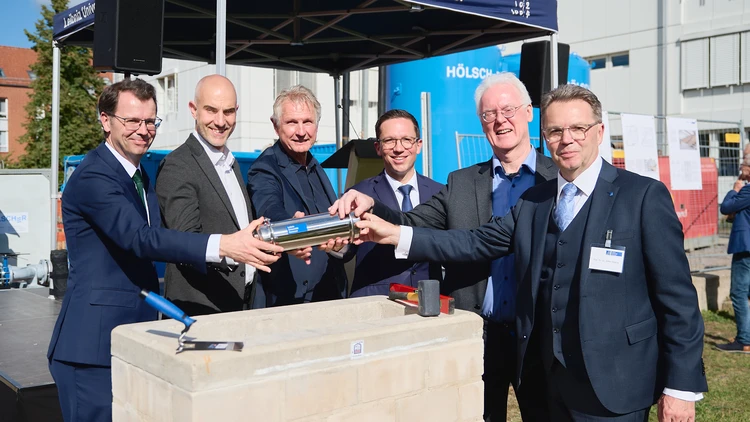
On 14 September 2026, the foundation stone was laid for the Digital Innovation Campus (DIC) in Hanover. A new building for research, teaching and knowledge transfer in the fields of artificial intelligence and IT security is being constructed at the corner of Appelstraße and Schneiderberg. L3S will share the campus with the CISPA Helmholtz Centre for Information Security. The building is scheduled for completion by the end of 2028.
More than 4,000 square metres will provide modern work and meeting spaces, digital learning and experimental laboratories, as well as space for interdisciplinary projects and spin-offs. The total cost is around €27.2 million, of which the State of Lower Saxony is contributing around €21 million.
Bringing AI and IT security together
The idea for the campus dates back more than eight years. At the time, L3S Director Wolfgang Nejdl and Sascha Fahl, now a professor at CISPA, developed the concept for a ‘Digital Innovation Campus Hanover – Artificial Intelligence and Security’. That idea is now becoming reality.
‘The special feature of this campus is already captured in the subtitle we chose back then: artificial intelligence and security – under one roof,’ said Nejdl at the foundation stone ceremony. In future, L3S and CISPA will conduct research side by side, sharing laboratories, projects and training opportunities.
The link between the two fields is becoming increasingly important as AI systems become more widespread. In particular, AI agents that can act autonomously and access other systems create new challenges for security, access control and monitoring. ‘Anyone developing AI needs to think about security. Anyone researching security needs to understand AI. That is precisely what this building is being built for,’ said Nejdl.
From research to application
The DIC will also strengthen links between academia and industry. L3S and CISPA are already working together with Leibniz University Hannover, TU Braunschweig and more than 30 other partners through the European Digital Innovation Hub DAISEC. Projects such as SOOFI, in which L3S is working on open European language and reasoning models, also connect research with practical applications.
For L3S, the foundation stone ceremony also comes in a special year: on 18 September, the research centre will celebrate its 25th anniversary. ‘Today, we are laying the foundation stone for the building where the next 25 years will take place,’ said Nejdl. L3S is scheduled to move into the new campus at the end of 2028.
Photo: They laid the foundation stone – from left: Dr Sebastian Herbeck from the Ministry of Economic Affairs, Mayor Belit Onay, Bruno Vennes (BHBVT Society of Architects), Minister for Science Falko Mohrs, Prof. Dr. Wolfgang Nejdl from the L3S Research Center, and LUH President Prof. Dr. Volker Epping