

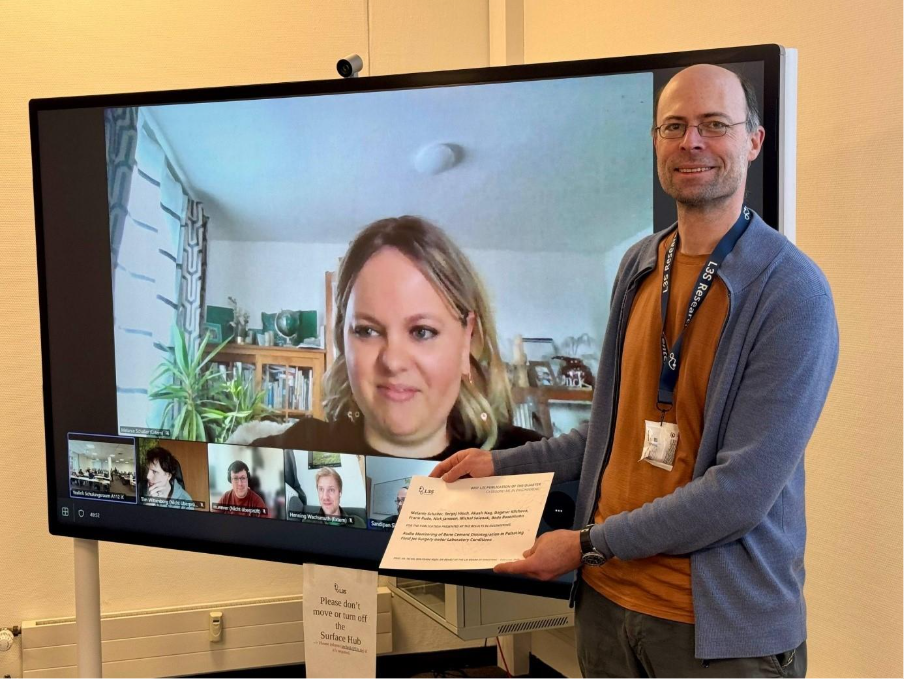
L3S Best Publication of the Quarter (Q3+Q4/2025)
Category: ML in Engineering
Audio Monitoring of Bone Cement Disintegration in Pulsating Fluid Jet Surgery under Laboratory Conditions
Authors: Melanie Schaller, Sergej Hloch, Akash Nag, Dagmar Klichova, Frank Pude, Nick Janssen, Michal Selenak, Bodo Rosenhahn
Published in Results in Engineering
The paper in a nutshell:
This study explores a pulsating fluid jet as a precise, cold, and minimally invasive technique for bone cement removal. A newly developed long nozzle enables realistic surgical conditions. Because splashing obstructs visibility, we introduce audio-based monitoring combined with our S4DBio algorithm to correlate sound signals with erosion profiles.
The system achieves a prediction accuracy of 98.93%, demonstrating that the fluid jet and audio monitoring form an effective cyber-physical setup for estimating erosion depth. The work provides key components for future minimally invasive, cold, and adaptive bone cement removal technologies.
Which problem do you solve with your research?
Revision surgeries that require the removal of old bone cement are often time-consuming, imprecise, and risky. Traditional manual techniques can lead to bone loss, fractures, or perforations. Our research demonstrates a gentle and automatable alternative that can significantly reduce risks for patients.
What is the potential impact of your findings?
The method has the potential to make revision surgeries faster, safer, and more precise. It opens the door to automating surgical steps that currently depend heavily on the experience of individual surgeons. In the long term, this could reduce patient burden, prevent complications, and improve the overall quality of orthopaedic care.
What is new about your approach?
For the first time, a pulsating fluid jet is combined with audio monitoring and a StateSpace Model (S4DBio) to predict bone cement removal in real time—without requiring visual contact. We also introduce a newly developed long nozzle that technically enables minimally invasive procedures. This combination has not existed before in surgical technology.
Link to the full paper: